
What is a pressure transducer?
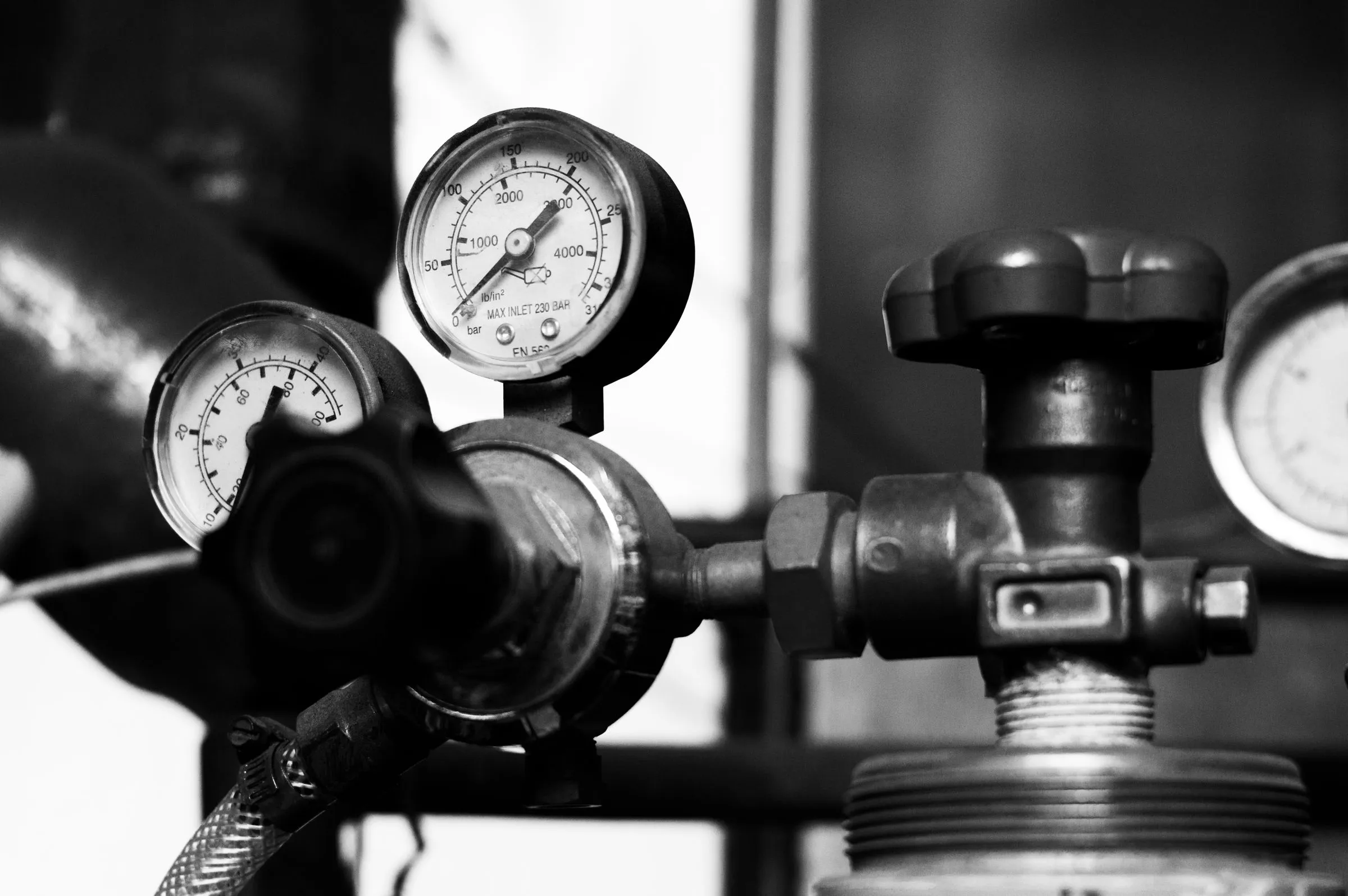
A pressure transducer is a sensor that converts fluid pressure into a proportional electrical signal. Most industrial models use strain gauges on a diaphragm that flexes under pressure. When the device outputs a 4–20 mA loop signal for process control, it is usually called a pressure transmitter.
Pressure sensors are among the most common instruments in any plant or test cell. They verify hydraulic system performance, protect pumps and compressors, measure tank level, control process pressure and provide safety-related signals in power plants. The differences that matter are how well a sensor holds accuracy across temperature, how it survives the environment and whether it carries the approvals the application requires.
How strain-gauge pressure sensing works
A pressure transducer is built around a sensing diaphragm, usually stainless steel, that deflects slightly under pressure.
- Strain gauges bonded, sputtered or fused to the diaphragm stretch or compress as it deflects, changing their electrical resistance.
- Four gauges wired as a Wheatstone bridge turn that small resistance change into a millivolt output proportional to pressure.
- Compensation corrects for temperature, which shifts both zero and span. Precision models, such as Spectre’s Zero-Drift line, are calibrated at multiple temperatures and corrected digitally.
- Amplifier electronics scale the signal to 0–5 V, 0–10 V or 4–20 mA, or leave it as mV/V for test data acquisition.
| Sensor type | Reference | Typical use |
|---|---|---|
| Gauge | Local atmosphere | Hydraulics, pumps, process lines |
| Absolute | Vacuum | Altitude, vacuum systems, test chambers |
| Sealed gauge | Fixed internal reference | High ranges, wet or submerged locations |
| Differential | Second process port | Filters, orifice flow, pressurized tank level |
| Submersible level | Vented gauge under liquid | Wells, lift stations, tanks |
Common applications
- Rocket and turbine engine test: chamber, feed and hydraulic pressure on test stands, work that is familiar in Huntsville and at NASA’s Stennis Space Center in Mississippi.
- Hydraulic systems: mobile equipment, presses and production test stands at the Southeast’s automotive and heavy equipment plants.
- Oil, gas and petrochemical: wellhead and process pressure in Class I, Division 1 areas along the Gulf Coast.
- Nuclear power: reactor coolant, pressurizer, feedwater and containment measurements in the Southeast’s commercial nuclear fleet.
- Water and wastewater: submersible level in wells, tanks and lift stations.
- Food processing: sanitary pressure measurement on washdown lines.
Choosing the right pressure transducer
The cheapest way to buy a pressure sensor is to specify it once, correctly. Define the pressure reference and range, then examine the dynamic environment: pulsation, spikes, vibration and shock that can fatigue a diaphragm. Next, look at thermal conditions, since a sensor rated at 0.25% at room temperature may drift far more on an outdoor test stand.
Finally, match installation details. A transducer that copies the existing process connection and electrical connector can drop in without rework, and Spectre will match an existing connector on request. In hazardous and nuclear service, approvals and qualification documentation are as important as the specifications.
Manufacturers we represent for pressure measurement
Spectre Corp designs, machines and calibrates pressure and temperature transducers in North Ridgeville, Ohio. Its Zero-Drift precision models are individually calibrated from −40 °C to 85 °C, and its catalog spans industrial, hydraulic, submersible, differential, sanitary and explosion-proof transducers.
RDP Electrosense offers strain-gauge gauge, absolute, flush-diaphragm and differential pressure transducers from about 542 mbar up to 6,895 bar, plus matching amplifiers and indicators.
Curtiss-Wright Round Rock, formerly Weed Instrument and Ultra Electronics NSPI, builds nuclear-qualified pressure transmitters, obsolescence replacements and extreme-environment transducers such as the NP9000.
Get local application support
We help engineers compare ranges, outputs, connectors and approvals, and coordinate factory quotes for standard and custom sensors. Visit engineering support, request a quote, or find your area manager on the territories page.